Posted in Peru on November 6, 2025
DWC, Lima Peru. Day 1
Starting off strong with everyone ready and eager.
Some worked on finishing off the composting holes as we have two to prepare. These will be used to compost and have rich soil for the garden. The school is very proud of their two garden areas. One is for the younger age group and then one for the older grades.
I understood that there is a national contest, and they are being judged to win supplies for their school. Wishing them all the success.
The other area we have been working on is behind the new building stabilizing a rock wall. Taking it down lower and removing loose rocks. All done manually.
Power of the force behind the sledge hammer, hammer, pure grit hauling these rocks out of the area with buckets to the other strong crew on the wheelbarrows, pushing these rocks across and up the road.
Everyone with a smile, laughter and encouragement.
Another project worked on today was preparing a couple walls in the new to be completed pastry kitchen. As they had a harsher winter and mold formed. Sanding, sealing and repainting.
Lunch once again was amazing. Prepared by two of the ladies, chicken rice potatoes with a sauce. Dessert was Tuna, the seed from the flowering cactus. Refreshing and tasty.
After lunch David, Ingelore and myself were off to visit a family of 4 at their home.
Samantha is 9 years old and in grade 3 at the school, her mom, Sonia who works with the breakfast program and her 1 month old baby, with the husband gone to work. He leaves at 4 am returning 8pm.
We were bussed from our site about 20mins, to the bus stop Samantha takes to school, hiked up a road for another 15 or so mins. To then climb one of the many stairways, a feat all on its own. About 20mins up and up and up.
The visit moved me more than I expected. The pride, gratefulness and welcoming was such an honor.
Sonia is very appreciative for the programs provided.
Bussing and breakfast programs have provided her family a healthier lifestyle, and more availability and access to help and understanding with the psychological challenges of the living situations.
Samantha had been very iron deficient, and shy. She now is healthier, with better eating habits and confidence. Samantha has expressed high interest in working at the schools kiosk, to learn skills that will assist with her life goals of having a clothing store one day and design her own fashion line.
Sonia volunteers with the breakfast program and while she spoke about her experiences and the changes, she sees much progress in her daughter, this brought me back, remembering raising my own children.
No matter how much we have, where, or how we live in the world, I believe our goals as parents is to help our children be their best, and we can’t do it alone. It takes a community to help raise and support our children.
Post submitted by Heather Cawthorpe Forsyth
DWC, Lima Peru. Week 1
Volunteering at the remote school I.E., 7245 San José Obrero, near Lima, Peru, is proving to be an unforgettable and rewarding experience. The work can be incredibly tough and physically demanding — from digging compost pits, erecting rock retaining walls, painting classrooms, to carrying supplies up and down steep paths — but every drop of effort feels worthwhile when met with the warm smiles and enthusiasm of the children. Despite limited resources, the students’ curiosity and joy create an atmosphere full of energy and gratitude that continues to inspire the entire team.
My group met after school one day with a small, women led family – mother, grandmother and 2 young girls who attend the school, while another older child has left home for further studies. Astonishingly, the women started a community kitchen during the covid pandemic due to the overwhelming need to feed those who didn’t have enough. Largely sourced through donated food, with some assistance from Peru social services, the women continue to serve approximately upwards of 55 meals per day. Their heartfelt expressions of gratitude towards the bus and breakfast programs that benefit all the children brought a tear to one or two of the volunteers.
The organizers are exceptionally supportive and well-coordinated, making sure that volunteers feel welcomed and that their efforts truly benefit the community. Their dedication and care ensure that each day’s challenges are balanced with meaningful progress and genuine connections. By the end of the project, this group of volunteers will not only see tangible improvements at the school, but also leave with lasting memories of teamwork, purpose, and heartfelt appreciation from everyone involved.
Post submitted by Sheila Turner
DWC, Lima Peru. Week 2-Tuesday
I take a moment to reflect on Remembrance Day and my blessings.
We get a late start today after a busy weekend visiting Cusco & Muchu Pichu with some of the team arriving in just before 1am. Feeling bleary-eyed & a bit sluggish as we glance around the site to see what’s changed since we were away. Miguel has shortened the back shed to allow space for a little garden and poured a cement boarder. Some rocks have been cleared from the cliff & fallen to the path. The privacy/security fence surrounding the large compost garden enclosure has fallen and will need to be repaired.
A team of 11 that has meshed well quickly divide into groups. Removing some large rocks above the door to continue the retaining wall. Parging the back retaining wall under the direction of Miguel; clearing the rubble, rocks & garbage; hauling sand to mix cement to extend the retaining wall higher. Repairing/bracing the compost garden’s privacy fence
There still time to break and enjoy a wonderful talent show by the children & lunch before we’re back to work.
With the dust blowing it’s easy to get caught up on the struggles of these families & community. Then you interact with the children; happy, playing, learning, they initiate many of the projects to better their school and community & have dreams like all children, you can see the beauty here.
Post submitted by Lise Caouette
DWC, Lima Peru. Week 2-Wednesday
Retaining Wall – A Day to Remember
Today’s Ryan & Shirin Bus Ride and Breakfast Club was nothing short of extraordinary. Imagine 69 excited children on a bus designed for just 22 seats — and yet, not a single complaint. What stood out most wasn’t the chaos, but the kindness. At breakfast it was inspiring to see the older children helped the younger ones, sharing their forks and spoons without hesitation. One touching moment saw a 7-year-old carefully feeding a 3-year-old — a simple act that said everything about the spirit of this community.
Geoff, Lisa, and Jamie went for a family visit, along with Christopher, the ever-energetic bus coordinator, and Stefino. Sadly, Geoff and Sheila missed out on today’s much-anticipated PE session — something they were quite disappointed about!
Lunch, as always, was a feast. We began with a gourmet starter of egg and potato in a creamy pepper sauce (crema de pimiento con quinoa), followed by a hearty main course of beef steak and rice served with a smooth potato sauce (asado de carne con puré de papa). Fresh mango rounded off the meal perfectly.
After lunch, Shirin headed out shopping, picking up clothes, materials, and food for local families — a simple gesture that will make a huge difference. Meanwhile, others continued their hard work building the flower bed retaining wall.
Ken & Shelia had the opportunity to help make the kids kiosk ready for painting as it looked tired, it was all the more special as the kids helped with the work
There was laughter too: Ryan, ever the joker, couldn’t resist splashing a bit of water on the ladies mixing cement. In his defence, it was a warm 23°C day — and they really did look like they needed cooling down!
To round off the day, the children enjoyed a special event — a poetry presentation contest themed around the environment, proudly sponsored by a local cement company. It was inspiring to see their creativity and passion on full display.
Post submitted by Ryan & Shirin
DWC, Lima Peru. Week 2-Thursday
It is difficult to convey the experience of this trip with facts alone. Each day includes new events and experiences of sight, sound, smell and touch, combined with a myriad of emotions.
Returning from the vast beauty of Cusco to the worksite in the dusty monochrome hills of the Via Maria del Triunfo and the San Jose Obrero school, it occurs to me that most here will not have the opportunity to see their national treasure in their lifetimes. Elvira, our team leader’s counterpart with IFIJANT for example, said that she had not yet had the opportunity to go. And yet the hills above Lima are filled with joy and have their own unique beauty. The school’s children are neatly dressed in clean clothes and generally love their teachers and school. The same personal dynamics exist amongst the students as elsewhere, there are popular kids and quiet ones, friendships, haves and have nots, kindness and meanness, rule followers and rule breakers; no doubt some anger and sadness, but mostly playfulness and joy.
Our hard-working Foreman Miguel is patient with us as we struggle with the language. Yesterday, as he stood atop a broken ladder, he called out instructions to us: “Mix!”, “pierdas”, “pequenos” “mas grandes” “platos”. Occasionally asking for someone to steady the ladder or make the concrete wetter or dryer. Throughout he smiled and laughed, sometimes with us sometimes at us. In the end he expressed gratitude for our efforts as we etched our names in the new concrete wall and had our photo taken with him.
Yesterday, Lise, Jamie and I visited the home of Sr. Carlos, a single father of two boys, 10 and 8. He volunteers in the community kitchen, the first man to do so. His kids participate in the breakfast program. He patiently answered our questions about his life: he is industrious and self-reliant, not of the view that the government can or will help him. He does the ‘1000 jobs’ of a single parent and engages in various business ventures to earn money to support his family, still finding time to take electrical courses and volunteer. He offered us a drink from the inventory of his small drink stand. After playing some soccer with the kids, his face lit up when I asked if he had a favorite team. An engaging fellow living in difficult circumstances living in hope for a better future for himself and his kids.
Post submitted by Geoff Jeffery
DWC, Lima Peru. Final Post
Stone Soup
The moral of the folktale “Stone Soup” lies in the power of community cooperation.(1)
The sky is often blue with soft white clouds, but the terrain itself is unforgiving. Oppressively dry and dusty, only the heartiest of plants survive. Blanketed in dust, they seem to be unfazed by the conditions, sprouting randomly and offering a stray splotch of green and sometimes orange, red or yellow. Steep roads are crudely cut, meandering haplessly upward, the hardened earth marred by rocks and gravel and pitted by holes left by dislodged rocks. Large trucks for construction and water lumber laboriously forward, rudely cut off by intrepid tuk-tuk drivers making their way through the human settlement picking up and dropping off in perpetual toil.
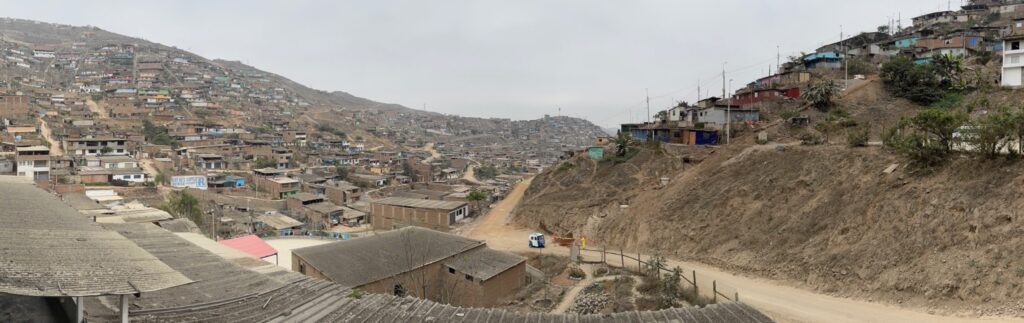
The human settlement is made up of scores of roughly hewn structures precariously clutching the hillside — tiers and tiers of makeshift homes accessed by an endless number of sheer mile-high concrete stairways, many unfinished and none with so much as a rail to support the weary traveler. Though often open for airflow, the houses have doors or deeply leaning gates, but most windows remain without glass. An outdoor table and chairs offer a bright extension to the limited interior spaces.
Poverty in the settlement is tangible. It cuts through every fiber of existence: food security, employment, hygiene, medical care, etc. And while the government could certainly do more, the human settlement is not entirely forgotten. Evidence of this is in the roadways, as crude as they are, and the constant thrum of construction of an otherwise nonexistent sewage system. Water is delivered weekly into the 1100-liter tanks that rest outside each house.
Payment, due upon delivery, is monitored by the government. A drop in overall use by the settlement results in a reduction of water delivered to the area. Most structures have some electricity, which is paid through a national debit system online. Thankfully, cell phone coverage is common or communications other than word-of-mouth would be non-existent, as there is no postal nor news service in the region.
(1) https://en.wikipedia.org/wiki/Stone_Soup
The painful realities of poverty, however, have been met by an unwavering and palpable sense of community here. Time and again, it is the strength of community in this human settlement that has carried the inhabitants forward. The perseverance and collective ingenuity of parents kept the children fed during the pandemic. Even today, families volunteer to operate community kitchens with only small government rations to feed upwards of 60 people. The neighbors keep an eye on the children waiting for the school bus and monitor each other’s water delivery, so no one needs to choose between going to work, looking after their kids, or getting water.
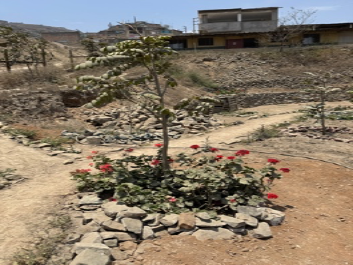
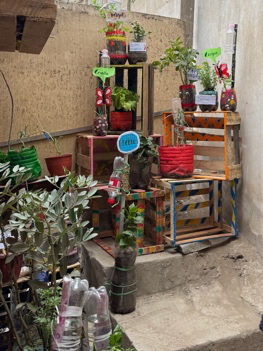
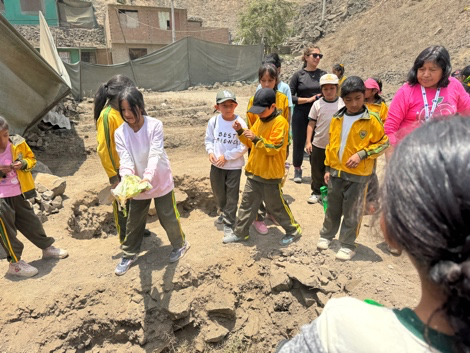
In the midst of the interminable dust and construction noise lies the I.E. 7245 San José de Obrero school (2), a small but bright glimmer of hope for the community. Within its classrooms students learn the basics, but they also learn about sustainability — cooking, gardening, composting and irrigation, all critical skills
for the health of the community at large. In fact, San José de Obrero is more than a school, it is the epicenter and pride of the human settlement — a place to gather, to learn and to help one another.
Despite the hardships, the children arrive at school in clean uniforms, happy, well-mannered,
and eager. The Mobility and Breakfast programs supported by both IFEJANT(3) and DWC(4) are a
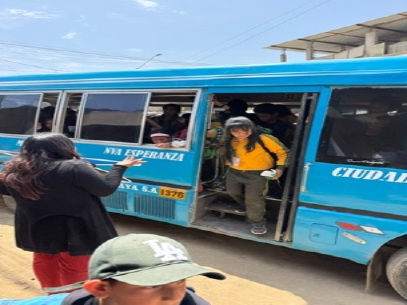
source of pride for the school. The bus provides mobility to the 69 young students who would
otherwise be unable to attend, as city buses ignore the reduced fare of scholars in favor of
the full fare of adults; but at least being ignored eases the fear of strangers.
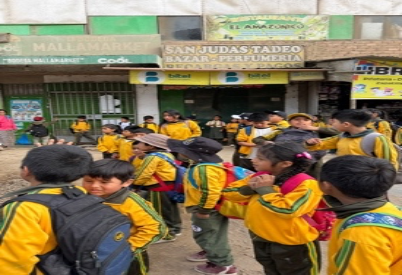
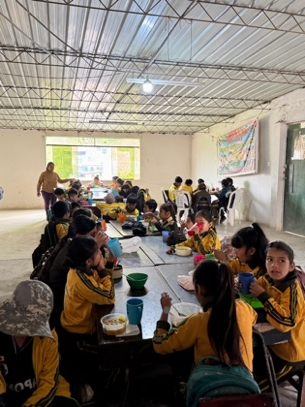
The poorest of children also participate in the Breakfast program, which offers a nutritious
meal before classes. In orderly fashion, the children arrive with their bowl, cup, and spoon,
place it on the table near the kitchen, wash their hands, and find a seat at the table. Their individual bowls and cups are filled, and the children are served. As every morsel of food and the last drop of Chicha Morado or tea has been swallowed, each raise their hand for a piece of fruit.
(2) Institución Educativa 7245 San José de Obrero is a school located in the Nueva Esperanza neighborhood of Villa María del Triunfo in Lima, Peru. It is named after San José Obrero (Saint Joseph the Worker) who is the patron saint of workers, honored for his role as Jesus’s earthly father and for his work as a carpenter, symbolizing the dignity of all honest labor. https://www.ncregister.com/features/st-joseph-the-worker-reflects-the-value-of-labor
(3) http://www.ifejant.org.pe
(4) https://developingworldconnections.org
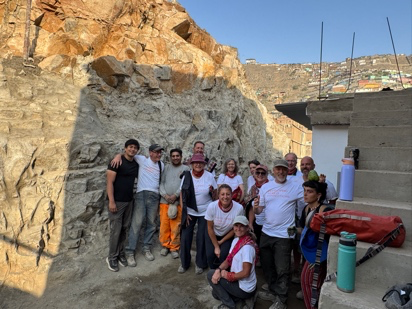
As volunteers, we were free of the day-to-day responsibilities of the human settlement, which made it easier for us to collectively tackle projects that require a finite but sustained effort, like building retaining walls, installing shelving, pouring concrete steps and digging compost pits. These efforts are, of
course, very important to making the school building and property safe for students and teachers alike… But the magic is in the classroom.
Our time with the children and families of San José de Obrero school was a privilege. We got
to squeeze onto the bus with 69 of our newest friends, serve breakfast to the little ones,
attend a student talent show, participate in PE classes and even lend a hand at the school
kiosk. But this story isn’t about volunteers, the hosts of volunteers who came before and will
continue to lend a hand in the future. This story is about the power and strength of the
community working together for the common good. It’s about being a part of something
much bigger and much stronger than any of us alone.
Post submitted by Jamie Langston
Posted in Peru on November 6, 2025


